What Does a Carpenter Bee Look Like? Identification Tips
If you are asking what does a carpenter bee look like, focus on the bee’s shape, body texture, and behavior around wood rather than relying on one color or quick glimpse. A carpenter bee is often large and sturdy, with a smooth-looking, shiny abdomen and a fuzzier middle section. It may investigate exposed wood, but one bee or one opening does not confirm nesting or damage. Observe from a distance and combine clues before deciding what to do.
What does a carpenter bee look like?
Carpenter bees are robust bees, commonly dark-bodied, with a broad appearance compared with many small flower visitors. The abdomen—the rear section—often looks black, smooth, and shiny, with little visible hair. The thorax, the section behind the head, can look fuzzy or bear pale yellowish hairs. Exact colors and markings vary, so treat these as useful clues rather than a guaranteed identification test.
Try to notice several features together. The bee may look large and solid, though distance can make size hard to judge. Its abdomen may look relatively bare and reflective, while the thorax can appear visibly hairy. Repeated visits to a wooden beam or trim are worth noting, but hovering alone does not prove a nest.
Lighting can make dark body parts look different, and wings may hide the abdomen from some angles. A quick glimpse is rarely enough to identify a bee with confidence. If you can safely take a photo from where you already are, it may help you compare features later; do not move closer or use a ladder just to get a better view.
How can you tell a carpenter bee from a bumble bee?
The abdomen is often the most helpful place to start. Bumble bees typically look fuzzy across much of the body, including the abdomen, and may show bands or patches of contrasting color. Carpenter bees commonly have a smoother, shinier abdomen and a hairy thorax. Both can look large and fuzzy at a glance, especially when seen in motion.
Use this comparison as a field guide, not a definitive species key. A bee seen from behind may not show the thorax clearly; one facing away may hide its abdomen. Sun glare, shade, distance, and motion can all affect what you think you see. If clues conflict, keep the identification open rather than forcing a conclusion.
Clue | Carpenter bee pattern | Bumble bee pattern |
Abdomen | Often smooth-looking, dark, and shiny | Often visibly fuzzy, sometimes patterned |
Thorax | May be fuzzy or pale-haired | Usually looks fuzzy |
Where you notice it | May investigate or hover near wood | Often seen visiting flowers |
What the clue establishes | Suggests a possibility; does not prove a nest | Appearance alone may not confirm species |
Behavior adds context, not certainty. A bee on a flower near a deck may simply be visiting the flower. A bee repeatedly returning to one opening in a wooden beam gives you a reason to document that location, but the opening might be old or have another cause. Avoid treating or sealing it based on this comparison alone.
What does a carpenter bee hole look like?
Carpenter bees may make round entrance openings in wood. A neat-looking circular hole on an exposed surface can be a clue, especially when bees repeatedly approach the same point. But a round mark does not identify its maker by itself. Old fasteners, prior repairs, other insects, and weathering can leave openings or marks that look similar.
Notice the surrounding context without touching the wood. Is the opening on a beam, fascia, rail, or trim? Do bees revisit it? Are there fresh-looking wood particles below it, or only old marks? Is the wood painted or bare? These observations can help explain the situation, but they do not establish whether an opening is active.
Do not insert a tool, probe the opening, spray into it, or seal it while you are unsure what created it. Disturbing the area can put you close to active insects and may make later assessment harder. Take a wide photograph that shows the opening in the structure, and a closer one only if you can do so from a safe position.
How should you observe a suspected carpenter bee safely?
Watch from a comfortable distance, preferably from a sheltered place. Do not swat at bees, handle them, stand directly beneath repeated activity, or disturb a suspected nest. Avoid climbing a ladder to inspect a high eave or beam. If activity is beside a doorway, walkway, seating area, or play space, use another route when practical and keep children and pets away from the immediate area.
There is no need to provoke an insect to see how it reacts. A useful observation is one made without approaching, striking, or trying to flush the bee out. If you cannot see body details clearly from a safe distance, record that you saw a large dark bee and describe where it was. Uncertainty is more useful than a confident but unsupported identification.
For general insect precautions, see the Centers for Disease Control and Prevention’s insect safety information. If someone has a serious reaction after a sting, seek urgent medical care rather than trying to identify the insect first.
What should you document before requesting help?
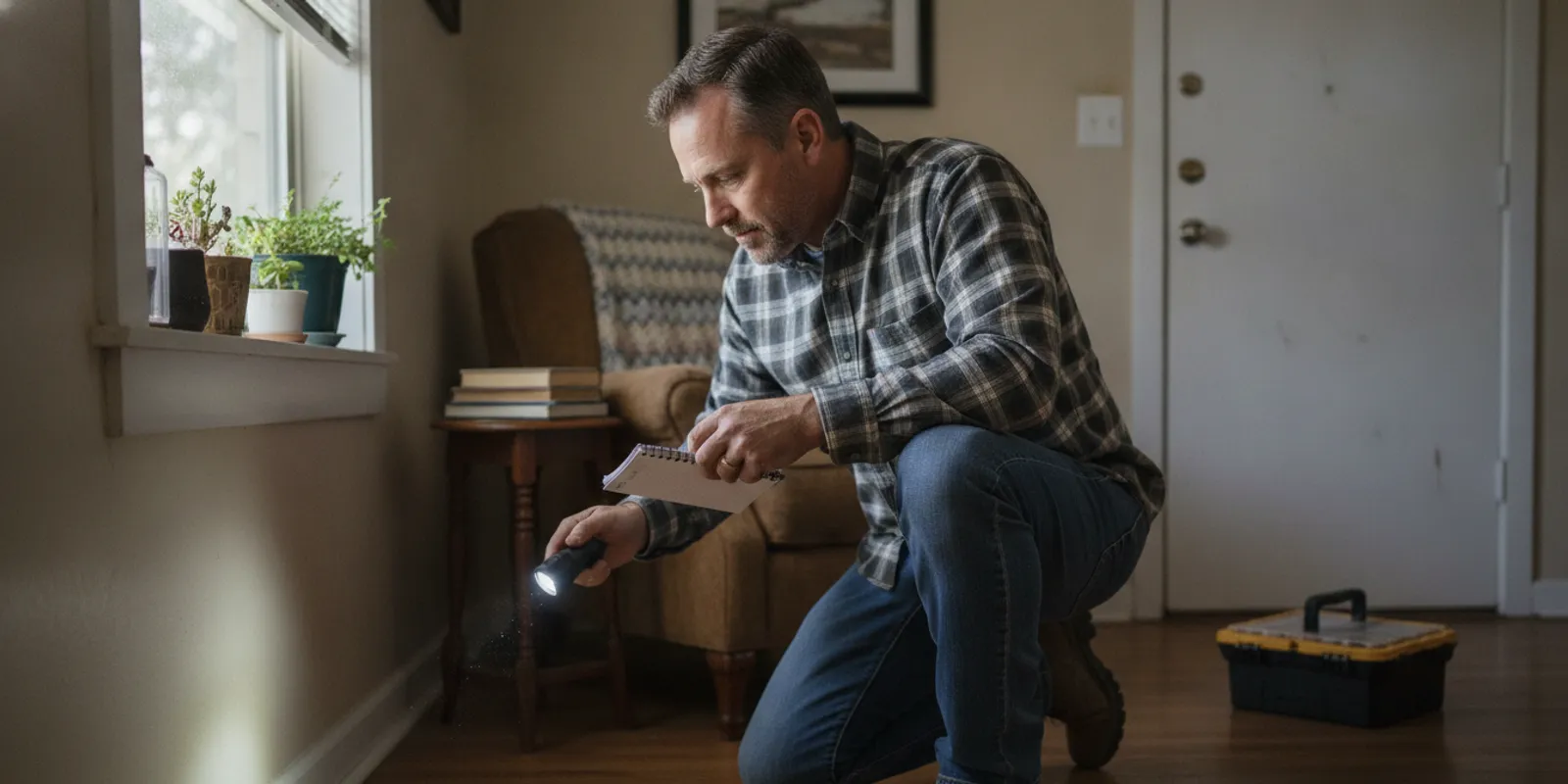
A short, factual record makes it easier to describe a concern. Note the location, timing, what you observed, and how it affects use of the property. Separate what you saw from what you suspect: “A large dark bee returned to a round opening on the porch beam several times this week” is more precise than saying the beam is definitely infested when that has not been confirmed.
Identify the structure or surface: porch beam, fence, eave, fascia, rail, or another wooden feature.
Record when you first noticed the bee and whether it returns at similar times or repeatedly visits the same point.
Describe visible features, such as a shiny abdomen or fuzzy thorax, only if you could see them clearly.
Note any opening, wood particles, or changes in the surface without probing or touching them.
Say whether the area is near a frequently used entrance, walkway, customer area, or play space.
Keep any photos you already took safely; do not take additional risks to improve them.
Include property type and ZIP code if you ask about service. Pro Pest is based in Sealy and describes service in Sealy and the surrounding area; a particular address should be checked rather than assumed to be covered. You can also explain whether you are seeking a one-time assessment or asking about ongoing service, without presuming a particular plan or schedule is available.
When is an inspection a useful next step?
An inspection may be useful when bees repeatedly visit one section of wood, when you find openings you cannot explain, or when activity is close to an area people need to use. It can help distinguish a possible carpenter bee concern from another insect or old marks. The useful order is to assess the activity and site conditions first, then determine whether targeted treatment is appropriate.
Pro Pest describes a free, no-obligation inspection request. A request is not a confirmed appointment or a fixed-price quote. If you are considering help, describe the insect as suspected rather than confirmed when unsure, and provide your ZIP code so availability can be checked. Read about the company’s pest-control services and its Sealy-area background.
What changes for a business or rental property?
For a commercial site, record where the activity falls in relation to entrances, customer areas, loading zones, and staff routes. Note whether the suspected opening is on the building, a freestanding wooden structure, or another feature. Avoid asking staff to investigate the opening or apply an unapproved product. Keep people away from the specific area when practical while the concern is assessed.
A property owner or manager may need to coordinate access with maintenance staff and identify a suitable time for inspection. Share access constraints and whether activity affects a customer entrance or routine work area. Pro Pest’s commercial pest-control information describes its commercial service context; the appropriate next step depends on the property, location, and findings, not a general assumption about every site.
How do common sighting situations change your next step?
One sighting can mean very different things depending on where the bee was and whether it returned. Consider the situation as a whole instead of treating a single feature as proof.
A bee passes through the yard
If a large bee crosses the yard or visits flowers and you see no repeated activity at wood, there may be no reason to identify it more precisely right away. Notice whether it returns to the same wooden surface. Do not pursue it for a closer look.
A bee hovers near a porch beam
Repeated hovering near one beam is worth recording, especially if the bee approaches the same point each time. Still, hovering does not confirm an entrance or nest. Observe from a distance and note the exact section of the beam.
You find a round opening but no bee
A round opening may be old, inactive, or unrelated to bees. Photograph its position and surrounding wood, then avoid poking or filling it. If it is near an area used often, explain that context when seeking an assessment.
You see several bees around a building
Describe where each one was seen and whether they converged on a single location or were scattered among flowers and outdoor features. Multiple sightings are not automatically evidence of one nest. A simple sketch or a few safe, wide-angle photos can clarify the pattern without requiring close inspection.
What should you avoid doing?
- Do not rely on color alone.
Lighting and distance can change what you see.
- Do not label every round opening a bee nest.
Other causes and old marks can resemble an entrance.
- Do not block an opening immediately.
First establish, as far as possible, whether it is active and what may have created it.
- Do not spray an unidentified insect or hole.
An incorrect treatment can create risks and complicate assessment; follow product labels and qualified advice.
- Do not assume one observation proves a property-wide problem.
Record the location and repeat activity, if any.
- Do not make a treatment decision from a photo alone.
Material, activity, access, and surrounding conditions also matter.
If you see only an occasional bee near flowers, note whether it interacts with wood before deciding that the structure is involved. If it repeatedly visits an opening, or the area affects everyday access, keep your distance, document what you can safely observe, and consider an inspection-led assessment.
How can you make a useful inspection request?
Before contacting a provider, gather details that let the concern be understood without guesswork: property type, ZIP code, exact area, how often activity occurs, and whether you noticed an opening. State what you know and what remains uncertain. A concise report can be more useful than a long list of possible insect names.
For example: “At a Sealy-area home, I saw a large dark bee return to one round opening in an exterior porch beam on several afternoons. The beam is near the main walkway. I have a photo taken from the yard, but I have not touched or treated the opening.” This includes location, pattern, impact, and evidence while avoiding an unsupported claim about species or condition.
For a business, add whether activity affects a customer entrance, staff route, or loading area, and identify who can provide access. For either property type, say whether you are asking about a one-time assessment or ongoing service. Learn more about residential pest-control information if the concern is at a home.
Frequently asked questions
Is a shiny black abdomen enough to identify a carpenter bee?
It is a useful clue, but not enough by itself. Consider the thorax, overall build, view quality, and setting as well.
Does a carpenter bee always make a visible hole?
Not every sighting is accompanied by an obvious opening. A bee near wood may simply be passing by or investigating a surface, so behavior alone does not establish nesting.
Should I seal a suspected opening?
Do not seal it based only on appearance. First determine whether it is active and what created it; probing or sealing can disturb the site and make assessment harder.
Can I identify the bee by how it flies?
Flight or hovering may provide context, but it is not dependable identification on its own. Combine behavior with visible body features and location.
What should I send with an inspection request?
Share your property type, ZIP code, location of activity, timing, what you observed, and any safely taken photos. Make clear which details are certain and which are guesses.
Carpenter bee identification is most useful when appearance, behavior, and setting are considered together. When signs remain uncertain, keep your distance, record what you can safely observe, and let an inspection guide the next step.
Comments